Tuesday, June 06, 2006

More Mission

I was wrong about going to Pine Ridge today--we spent more time on the Rosebud Reservation, learning about Lakota culture and Indian education. Our tour of Pine Ridge is tomorrow, for real this time.

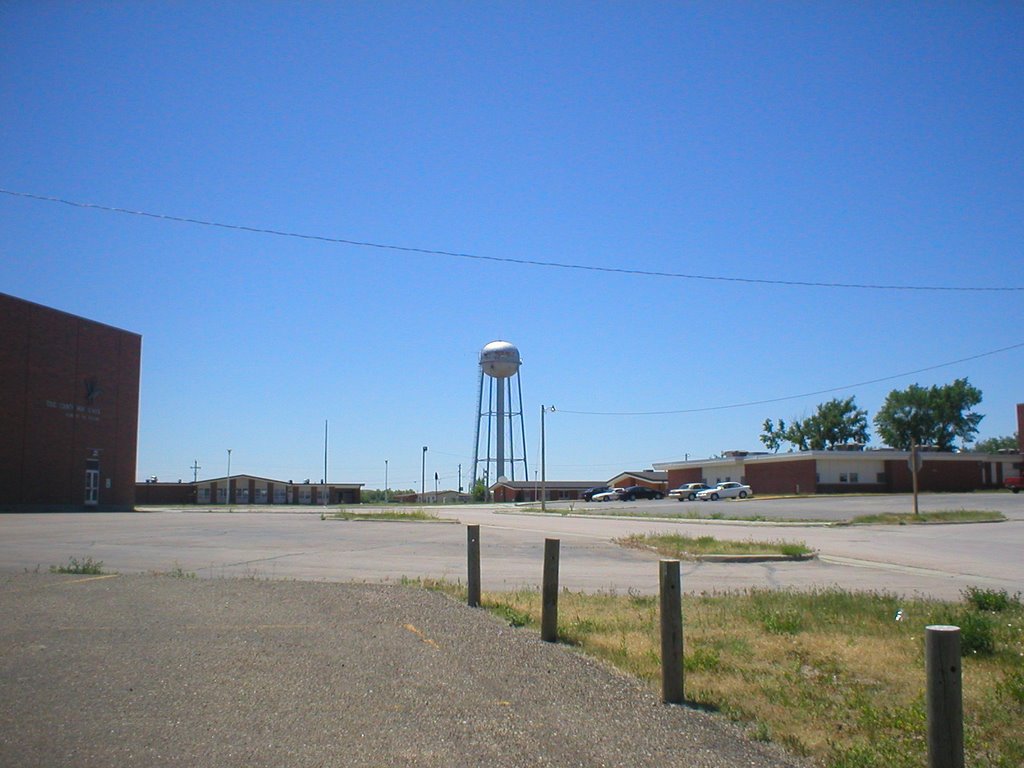
Here are a couple more pictures of the town of Mission. First is Todd County High School, where a number of TFA teachers will be placed. It much larger than Crazy Horse School, where Luke and I will be teaching. We took a look inside later, and it looked like a typical high school, if less decorated than mine was. Outside the gym, there were three shelves completely crammed with Track and Field and Cross Country Trophies. Lots of State Championships. I read an article in Lakota Country Today that mentioned another runner doing well at State this year.

Next is a shot of the town's water tower, located just behind the school:


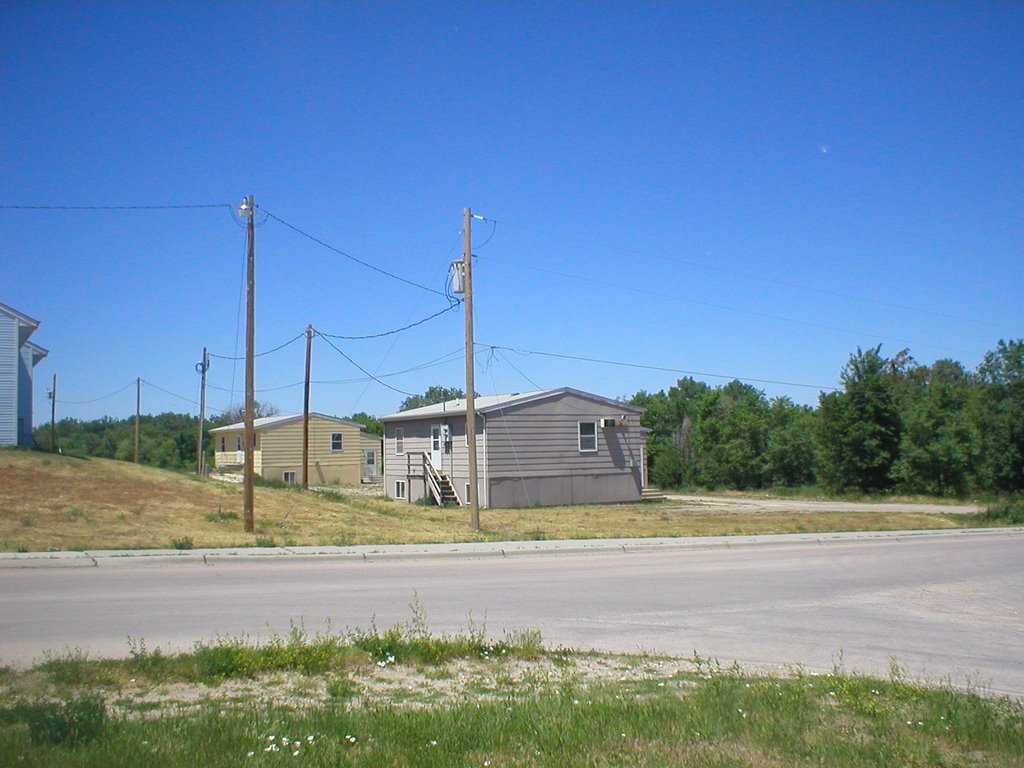
And, finally, a shot of some of the teacher housing, which should be similar in Wanblee. It is just a few hundred feet from the school:

Misconceptions & Wolakota

In my rush to post pictures yesterday, I forgot to mention an interesting conversation I had with on of the owners at the Soldier Woman Gallery. I had noticed American flags on a lot of the art work. Based on my own interpretations of some of the local history, I thought that the Lakota would not want much to do with the American flag as a symbol, and so these flags were there because they helped move the merchandise. When I asked about it, the owner began by noting that the Lakota believe that flags were very powerful symbols and would often wear the flags of their enemies in order to absorb some of their power. But he went out to note that many Lakota are very patriotic in a traditional, American sense, and that Native Americans are disproportionately represented in the military, in part because they are a warrior culture. There are many veterans on the reservation who fly American flags, and feel content to have served their country even if they do little else upon returning. So it looks like my pacifist, liberal upbringing blinded me to the real truth of the situation.

Another surprise that I mentioned yesterday was the way the Catholic Church and the Lakota culture seemed to mesh so well. At St. Francis, which is now controlled by a local school board, the presence of Catholicism is still celebrated at the museum. It seemed (and seems) strange to me, because as much as Father Buechel did to document and preserve Lakota culture (he took many photographs and created a Lakota-English dictionary), I find it hard to separate that preservation work from the assimiliation that missionary work intends. Of course, I have a very limited perspectivce on these types of issues.

Today Duane Hollow Horn Bear, a professor at Sinte Gleska University and descendent of Chief Hollow Horn Bear, spoke to some of these issues with a presentation on Lakota language and culture. He started by describing his own life story, especially his spiritual reawakening after returning from the Vietnam War as a drug addict and alcoholic. He took on a medicine man as his mentor for ten years and learned many of the Lakota spiritual traditions. Today he does a lot of work to preserve these cultures. When his son, for example, preferred to watch MTV rather than learn a traditional song, Duane sat down and watched the show, too. Afterwards he called MTV and told them that if they ever needed an Indian for the program, they should call him. And they did--he ended up on Road Rules, helping the cast members "face their fears." After that, the kids on the reservation paid a lot more attention to him. Duane also spends a lot of time in Italy doing work with Amnesty International and World Artists for Peace. He has repeatedly petitioned the Pope for a visit, but was always denied because he did not represent a sovereign nation. He eventually spoke with the Pope's emissaries, and explained how he understood that for two hundred years, the Pope's homeland was also denied its status as a sovereign nation--and soon after he was granted a ten minute audience with the Pope. When asked by locals why he would want to speak with the Pope if he is not Christian, Duane explains that the Jesus represents Wolakota, which, if I understand correctly, is the Lakota word for peace, acknowledging the interconnectedness of all things. Duane sees that many practicing Christians on the reservation only go to church for funerals and other events, and believes that their lives would be much more spiritually fulfilling if their embraced more fully whatever spirituality they chose--whether that be Catholicism of the traditional Lakota way of life.

Monday, June 05, 2006

Rosebud

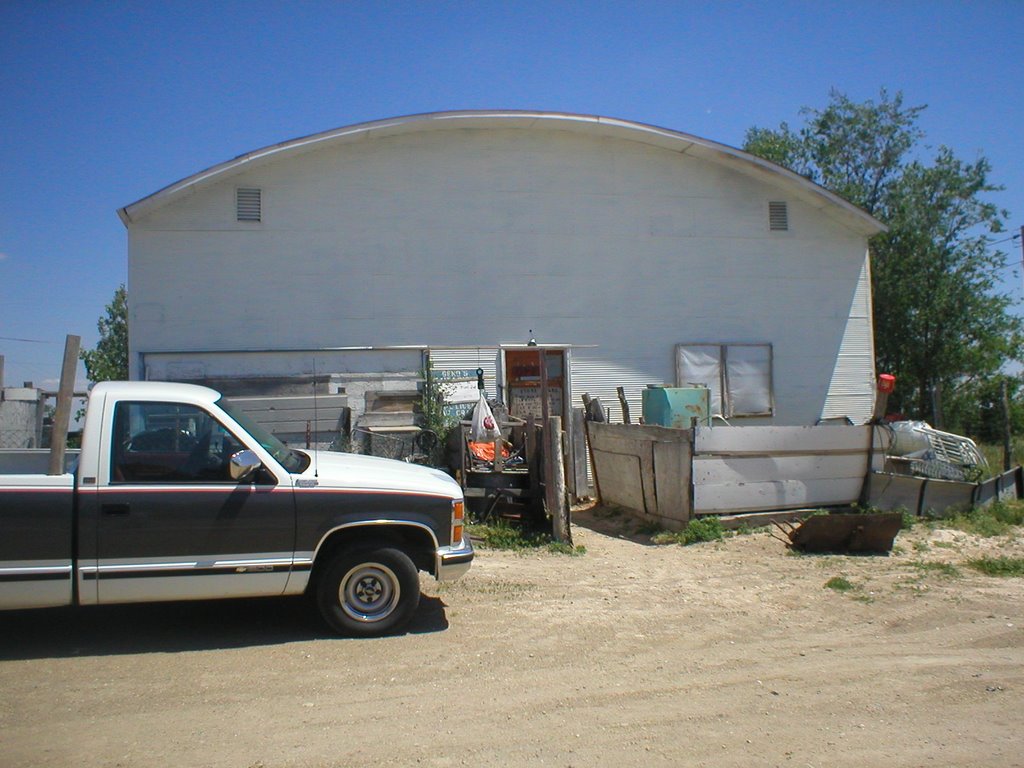
We spent today learning about Teach For America and exploring the Rosebud reservation. We spent most of the day at the Todd County Curriculum Center in the town of Mission. We had a little bit of break so Luke and I walked into town. The first place we passed was called, if I remember correctly, Gill's Bite and Bait. Here is a picture from out front:


Inside there was a strange mixture of merchandise: lots of guitars, lots of fishing bait and lures, and, behind a counter, "Indian artifacts." Luke talked to the man working inside, presumably Gill, about fishing in the area. He said that there were bass everywhere, and some trout. He suggested that it be cooked immediately after being caught--if you take it home before cooking, it won't taste good anymore.

Just up the road were a few stores. "Downtown" Mission stretched a little ways up and down the state highway, but at the intersection we were at, there was a grocery and hardware store and across the street a health clinic, as well as some boarded up buildings. This is a view of the grocery and hardware store:


Later on in the afternoon we went by the Soldier Woman Art Gallery. There were some cool old cars out front. This picture also might give you some idea of the landscape.


Later still we drove from Mission to St. Francis, where we saw a Catholic Church that is painted with both Christian and Lakota imagery. An anthropologist who teaches at Sinte Gleska University (on Rosebud) mentioned how there was no such thing as "Lakota relgion," but only a Lakota way of life, which helped elucidate how she and others were able to integrate traditional Lakota beliefs within their Christian worship. We also went to the Father Buechel Memorial Museum, which had a lot of artifacts from Lakota culture that have been preserved from when the missionaries first arrived on the reservation. I took two more pictures on the drive from Mission to St. Francis. The first indicates what the landscape typically looks like in the region. The second is near the town of Rosebud, near the Little White River, where it is a bit more hilly and forested. They aren't great pictures--they were taken from the window of a school bus. The second one especially doesn't really indicate what Rosebud looks like.


We are on the very western edge of the Central Time Zone here (Pine Ridge is on the very eastern edge of the Mountain Time Zone), so it stays light very late. I went out for a run at 9:20 and the sun was just beginning to set. I took a dirt road across from the casino out for a little over two miles. There was nothing but hills and grass around me, and, except for Luke and Jenny running behind me I was probably the only person around for miles. About a mile out I passed an abandoned barn, surrounded by some woods. On my way back a big buck jumped out of those woods, but when it saw me it turned back in and I didn't see it again. It was a spectacular sunset too--it's too bad I didn't have a camera.

Tomorrow we will be exploring the Pine Ridge reservation--my future home.

Sunday, June 04, 2006

Arrival


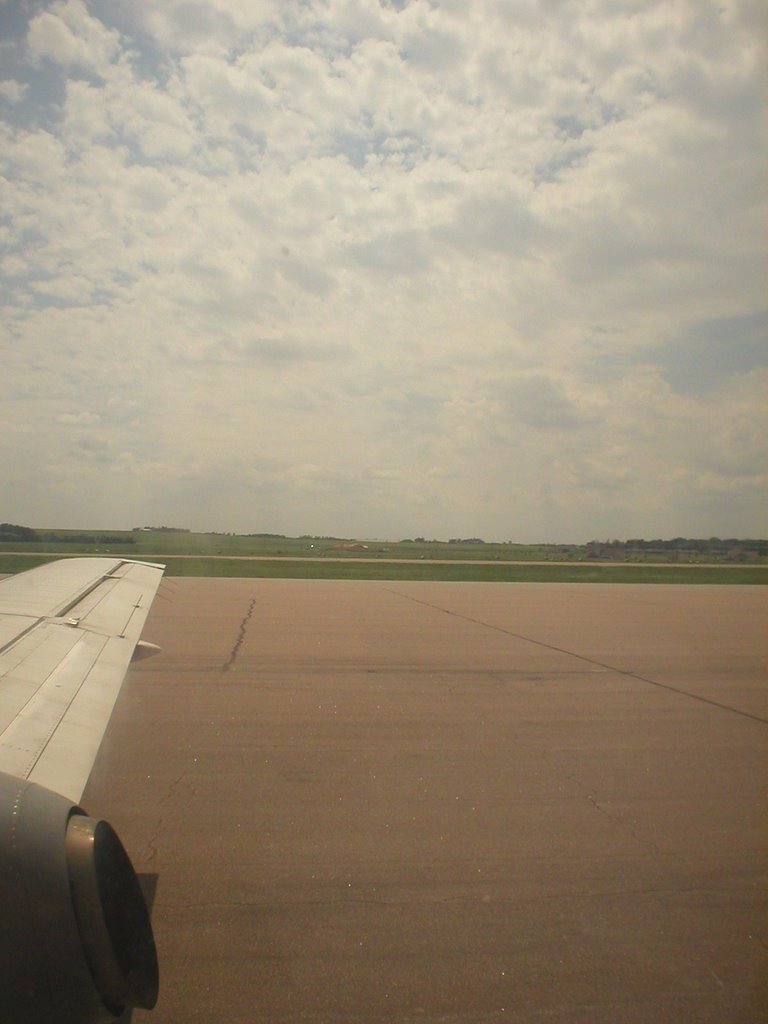
This is a picture from the window of my small, very scary plane at the Watertown Regional Airport. The plane wobbled violently at take-off and landing. I guess I'll have to get used to these planes if I'm living in South Dakota. As for the airport, I can't say too much about Watertown but it looked to be about the same as the Pierre Regional Airport, where I finally got off the plane. When I first heard "regional airport" I pictured something about the size of one Concourse at a normal airport. This was one building, about the size of a three car garage: one car worth of seating, one car worth of ticketing, one car worth of baggage claim, all in one room. There was also a little side room with vending machines. If it gives any indication, the airport had one men's room, with one stall and one urinal.


This next shot is coming down into Pierre, which again is pretty interchangeable with coming down into Watertown. Pretty stereotypical plains, very flat, very open. What really struck me was how few buildings were out there. From the air you can really see how empty this space is and how few people are down there, though the picture doesn't do much good.

Pierre (pop. 13,000) is one of the larger cities in South Dakota. It didn't strike me as being very different from any highway town somewhere in Ohio with a few restaurants and gas stations. Except in Pierre there is a very pretty state capitol building and a large governers mansion that is set very close to the road and has ridiculously little security by my paranoid, East coast standards.

Western South Dakota is very different from the plains I took a picture of above: more arid, hillier, and, I think, much prettier. I didn't take any pictures on the drive from Pierre to the Rosebud Casino, where we are staying, but I don't think a picture would have done the area much justice. I didn't really get a sense of the place until tonight when I went for a short run: you have to be outside, standing on the plains to realize how beautiful they are. It is a strange sensation of being both very open and very contained. Rosebud is apparently a very flat part of Western South Dakota, but even here the hills keep you from seeing too far along the horizon--but at the same time the sky is enormous. I think I am going to like it here.

Thursday, May 25, 2006

War Against Exploiters of Lakota Spirituality

I was bored last night, so I started cruising the internet looking for some information on Lakota "mythology"--although I guess a better, less offensive term might be Lakota spirituality. Eventually I came across this site, which is very full of information and is a little bit dry, so I wasn't able to penetrate it too far.

What I did read, though, was the Declaration of War Against Exploiters of Lakota Spirituality. Here are a few brief pieces from that:
WHEREAS for too long we have suffered the unspeakable indignity of having our most precious Lakota ceremonies and spiritual practices desecrated, mocked and abused by non-Indian "wannabes," hucksters, cultists, commercial profiteers and self-styled "New Age shamans" and their followers . . . .

WHEREAS sacrilegious "sundances" for non-Indians are being conducted by charlatans and cult leaders who promote abominable and obscene imitations of our sacred Lakota sundance rites . . . .

THEREFORE WE RESOLVE AS FOLLOWS:

1. We hereby and henceforth declare war against all persons who persist in exploiting, abusing and misrepresenting the sacred traditions and spiritual practices of our Lakota, Dakota and Nakota people.
A few other places in the Declaration they mention the "wholesale expropriation and commercialization of Lakota spirituality," which I agree seems detestable. I'm not sure how much room this sort of attitude leaves for cultural exchange, though. I mentioned the idea of Indian "wannabes" the other day, and Nate predicted that I would become one. I'm resistent to that label for these various reasons, but in going out to the reservation I do hope to learn about their culture and see what affect that culture might have on my own life. Does this make me a wannabe? The authors of the Declaration seem to believe that only someone who is ethnically Lakota can legitamately practice any element of their spiritual ceremonies. A different article I was reading, sympathetic to the views espoused in the Declaration, offers responses to various criticisms of such views. On whether or not one can be "Indian at heart," the article responds,
If you are a blood descendant of any of the indigenous People of the Western Hemisphere, then you are American Indian/Native American/First Nations/AK Native, or whatever your People may call themselves. If you are not - you are not. It's just that simple. It's DNA and genetics, not your lifestyle and how you "feel". Period.
I don't think I will ever claim to be "Indian at heart," but still, I'm not sure about this. I read another Lakota's dissenting response here, and while it is heartening to see that not everyone is so strictly exclusionist, the claim here that "People who ask for war are not people of peace" rings false with me. Though I know little about the Lakota culture, I'm not sure they were always "people of peace."

Wednesday, May 24, 2006

Wanblee, SD

The information is beginning to come in. It looks like I will most likely be teaching at Crazy Horse High School in Wanblee, SD, just south of the Badlands on the Pine Ridge reservation. The population of Wanblee in 2000 was 641, and as far as I can tell, the only places of business in town are a health clinic and a dental clinic. I will be about 25 miles from Interior, SD, a tourist town just outside Badlands National Park, and 35 miles from Kadoka, SD, where there are some restaurants. I'll be 111 miles from Rapid City, the big city for those of us from Western South Dakota. You can see a map of Wanblee here.

From the pictures I posted a few days ago, here is a shot of the Badlands "just outside" of Wanblee:

Monday, May 22, 2006

Some more cheesy preparatory thoughts: I've been reading River-Horse by William Least Heat-Moon, about his trek across America by river. As he crosses Lake Oahe in South Dakota, he writes:
Considered truly for what they possess, the High Plains are as exotic as any oriental realm at the end of the Great Silk Road—their flora, fauna, and their native habitants whose ancestors learned to hunt and sing and chip flint points in Asia long before Great Walls, pagodas, or paddy fields. Those nomads out of Mongolia came in search of a Northeast Passage that led them into a new world where mammoths and mastodons died out and the horse and camel were born.
Of course, for all the nice sentiments there, even Least Heat-Moon's ideas might not fly with some of the locals. I was glancing through a book by Vine Deloria, Jr., an important Lakota writer and thinker, and he denies the "Bering Strait theory of migration," claiming that it is a result of "residual guilt . . . over the manner in which the Western Hemisphere was invaded and settled by Europeans."

Sunday, May 21, 2006

"Go West, young man, and grow up with the country." - Horace Greeley

Graduation out of the way, the time has come for me to grow up: time for a real job. So for the next two years I will be teaching math and coaching track on a reservation in South Dakota (I'm not sure which one yet--either Pine Ridge or Rosebud). For all my claims of Midwestern roots, I've grown up in suburbia on the East Coast. On this journey West I'll be leaving behind friends and family and entering an entirely new world--so I hope this blog will allow me to illustrate that world for everyone back East.

To prep myself for what comes next, here are some pictures of the area that I'll be living in.